I was going to title this "Too Slow" but then I thought that that was too negative. There is also a difference between not keeping up and not pushing the pace.
Living on the east coast was good for me. Going to WPI was great for me. The urgency in the atmosphere that is exuded there is intense. That being said, to the best of my knowledge it has been over 20 years since WPI has had a suicide. MIT averages something like three per year.
The pace of classes is unlike any other college I know of. the year is divided into four seven week terms with a fifth term in the summer. Everybody only takes three classes at a time (although four is relatively common, and addicting). The point being, everything happens really fast. In the space of a week you can totally fall behind. Thankfully, I never had a sick day in 11 semesters of college and graduate school. Well I had one, but that was because I fell 40 feet climbing not because I was actually sick. Also, that happened during fall break, so I did not have anything to miss.
I was recently talking with an engineer with experience in Arizona, California, and Seattle, and he was commenting on how intense or hard working people in the midwest are. I tried to stifle the smile on my face. People in the midwest are extremely hard working. In fact in rural areas there are farmers and ranchers that maintain hours and a pace in their work that is simply astonishing. I'm not diminishing that at all. However, I think that in the midwest most people have a nice work-life balance. On the east coat it seemed to me that many people did not have a ultimately beneficial work-life balance. It was more like a work-work-life-work balance. My experience could be unique because of the intensity of WPI, but I had the feeling that many people on the east coast put in tremendous hours.
Every once in awhile at work I get to a point where I am waiting on someone else for the next step of my work. I apologize to other people for my impatience and demanding nature. While I may not show it often or try to hide it, and considering I like teaching I must be less demanding and more patient than I give myself credit for, the standards that I set in my head are ridiculous. If I accomplish 1/4 of the things I would like to I'll have more success than I can even comprehend at this point in my life. I feel that most people do not share my ambition for better or for worse.
Returning to the topic, you could die today. You could be paralyzed today driving home this evening. You could slip in the shower and break your neck. You could die of carbon monoxide poisoning tonight. All of those scenarios are highly unlikely, but the point is, if you want to do something you need to work toward it, today. I'm not going to try to describe any sort of strategy because I have no idea what you want to do in life. My life is pretty simple and my daily run or runs as well as engineering are two things that I am very thankful to be able to do every day which help me work toward several of my goals. I mean, how do you describe putting energy into your family?
The east coast and WPI put me through the ringer, as I hoped, and that coupled with life in the midwest, as well as family tradition, and not dying in Pakistan, has helped me bring a sense of urgency to my life, that I am happy to have. Perhaps, just maybe, I can be fast enough.

Showing posts with label tip of the day. Show all posts
Showing posts with label tip of the day. Show all posts
Tuesday, March 22, 2011


Thursday, June 4, 2009
Twittering, Texting, and SMSing
World this is a cultural shift that is happening right now. The transmission of information in 140 or 160 characters and less. A way to cheaply and quickly send a message that conveys some piece of information. Every little message is a way to teach somebody or a group of people something. Every message allows the reader to learn something. It can also be very contextual. The meaning of the message is very dependent on who sends it and when he or she sends it (example: "get over here now!").
What this implies for our culture is not entirely clear yet. In the past communication was by long winded conversations and telephone calls. Of course in many circumstances throughout history a short message was enough to convey all of the necessary information (example: "the British are coming!") although those circumstances did not seem to pervade society in the way that texting is invading life now. With more ways that ever before to stay in contact with people we often feel that we have shallow relationships. It is like we are alone in a crowd. Technology is for us to use, but we are not supposed to be used by technology.
Conversations can be carried out with exchanges of these short messages but I think their real power is either to ask and answer a single question or just to provide a piece of information. When there starts to be multiple questions and large pieces of information other forms of communication are more practical. It is a skill to be able to send short messages well. It must convey all the information and still make sense. A message with too many questions or made up abbreviations is not effective.
Do not run away from short text messages, but use them to save time and say what you need or just what you want; however, keep in mind there are other forms of communication which can be more effective and can save time, confusion, and even money depending on the situation.
Wednesday, April 29, 2009
Rope Soloing instruction of the week: Continuous loop
The continuous loop method of solo climbing is not continuous but it might involve a loop depending on how you set it up. No pictures but I'll summarize it.
1. Fix the rope at the bottom like for any typical lead soloing.
2. Tie the other end of the rope to a haul/rappel rope, and tie the end of that rope to the anchor or attach it to a haul bag.
3. Attach your leading device to the lead rope like you would to lead any pitch.
4. Stack the rope so that the rope goes from the anchor, to your harness, to the stacked rope, to the end of the haul/rappel rope.
5. Lead the pitch like any solo lead. At the beginning the weight will be very low but at the end of the pitch you will have the entire weight of the second rope on your harness as well.
6. Rappel the haul/rappel rope to the first anchor.
7. Second the pitch however it is you second pitches. The advantage of this for free climbing is that you can set up a system for seconding similar to what is described in the Silent Partner manual using the lead rope as your main belay rope with your SP, minitraxion, whatever and the other rope you can tie into the end of leaving some weight on the lead rope so your self belay device will feed easier. Of course if you have bolts at the belay you can set up a fixed line by passing the tied together ropes through the bolts as long as both ends at tied at the above anchor. When you finish seconding the pitch pull the rope through like a rappel.
Wednesday, April 22, 2009
Rope Soloing instruction of the week: Screamers
Belaying in roped solo climbing is very static. Wether you are using clove hitches or a Silent Partner the stop is very sudden. Many people use load limiting runners at the belay stations so that if they take a fall the force on the anchor will be reduced. For multipitch climbing It is very convenient to have two of them so that there is one at the lower belay and one at the higher belay. That way when you are setting up the anchor you can clip the Screamer (Yates brand load limiting runner) into the anchor and rappel directly off of that. A typical rappel will not generate enough force to tear a Screamer (unless you are using Scream Aids). The only disadvantage is that a screamer with a carabiner on each end is fairly long on the harness. I clip one of the carabiners directly to my harness to save the extra three inches.
Friday, April 17, 2009
Abaqus: Selecting Inside Surfaces
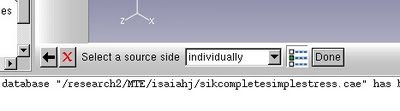
If you need to select an interior plane or surface but you are having trouble there is a way. First select the options button on the bottom of the screen between the drop-down box for how you select surfaces and the Done button.
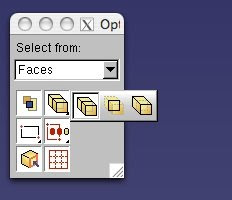
Second, select the surface type box within the Options box. The left option is all surfaces possible, the middle box is only interior surfaces, and the right box is exterior surfaces.
Monday, March 2, 2009
Ode to Abaqus
The past 18 hours have seen me work for perhaps seven or eight hours trying to select the boundary conditions for a finite element simulation in Abaqus because the server is running slow. When I finally selected everything last night i went to bed. This morning started with a three hour input file editfest trying to get everything to converge. Now on the sixth simulation of the day I anxiously wait for it to finish so that I can see the pretty pictures of mass diffusion concentration changes.
Simulation six of today: failure. The minimum time increment wasn't small enough.
The best part of these high tech computer programs are when the problem is a simple error message like: TIME INCREMENT REQUIRED IS LESS THAN THE MINIMUM SPECIFIED. Finite element has to be one of the coolest tools available to engineers today. However, understanding coding and boundary conditions and convergence is no simple task, especially as the problems become more complex.
Simulation seven of today: failure. Same reason.
In Analytical Methods class the other day we learned about finite element theory and it was interesting how stability criteria fix the time step based on the size of the element. It's fantastic how computers automatically change the time increments or concentration changes based on convergence and material properties because if I had to do one of these 40,000 node problems by hand I would never finish yet the computer let's me know I have a problem in only a few minutes.
Simulation eight of today: failure. Same reason. This time I'm changing the maximum allowable concentration change per element instead of the time increment.
1% inspiration, 99% perspiration - Edison. I have the physical results here in my hand that I am supposed to simulate so I can tell you what we should see but actually making it simulate that is a whole other sport.
FE tip of the day: In Abaqus Check the .dat file first for errors by scrolling to the bottom (my record is 13 fatal ones) they should be either specified throughout the file or will be listed on the .msg file. Second, check the .msg file for errors by first scrolling down to the bottom of the file and then if it is not listed at the bottom by carefully scrolling through the file. Since these files are often huge look for errors at changes in text. I mean there may be dozens of pages of warnings followed by a change to time increment changes and in between there could be an error about elements unusable for the time increment changes or maximum concentration changes.
Simulation nine of today: failure. Too many attempts at normalized concentration change. I changed the concentration change too much.
Subscribe to:
Posts (Atom)